Tuesday, August 31, 2021

Welcome Back!

 I am so glad to be setting up the classroom this year for in-person learning! It's like getting to renew an old friendship as I organize our class library, reassign class jobs, and bring back the class plants. These are small things, but it feels oh-so-good to be here, in this room, looking forward to sharing it with your children. I am grateful for this.

If we've learned anything from these past several months, it has been the power and value of resilience. I truly believe that children are some of the most resilient creatures on Earth. Yes, they will remember these times, but hopefully it will be with a feeling of pride that they were able to navigate it and emerge from it. I am grateful that I can join in that journey with them, guiding them in their resilience and growing confidence in their ability to overcome obstacles.

We have much to do in the days and months ahead. I am grateful that I will be able to do it alongside your students.

Friday, September 11, 2020

Virtually There

 When I began teaching seven years ago, we had a few classroom desktop computers, my teacher laptop, and a few iPads to use throughout the school. Apple had introduced it's smartphone only six years earlier. I had a slider cell phone with a qwerty keyboard which I mostly used for actual phone calls and a few texts. My, how far we have come! 

Your student is truly a "digital native", never having known a time without smartphones and internet access. They literally have the world at their fingertips and can carry the equivalent (or more!) of the Encyclopedia Britannica in their back pocket. That is an awesome and powerful thing that, when used well, opens up so many possibilities. This year, we will be learning how to make the most of those possibilities. We will make mistakes and gaffes along the way. But without some failure comes very little learning. 

In the past few months, I have learned more about technology than I ever thought I would. I have much more to learn. I will most definitely be learning along with your students, and I am certain that they will teach me things as we go. While it may not be the kind of school day that we envisioned, keeping our own attitudes positive and open to new challenges will encourage our "digital natives" to be resilient and adept at solving problems as they come up.

Monday, May 8, 2017

MCAS and Mindfulness

     It has been a somewhat stressful couple of weeks, but we are in the home stretch. The students have been fantastic as they have tackled the ELA and math MCAS. Their focus as they worked through the problems was palpable. And I was glad to hear that some of them chose to use mindfulness if they felt that they needed a mental break while taking the assessments. Several students also requested that we take a minute or two before diving into the assessments to be mindful, to calm our bodies and our minds, and to just be present in what we had to do. I was so proud of them through the whole process.

     When we started this journey of mindfulness at the beginning of the year, some students were doubtful that it would work for them. Some of my most incredulous students now regularly get comfortable, close their eyes, and just breathe for a few minutes. They've learned that it's easy to take advantage of this time to refresh themselves and to reorient themselves to the task at hand.

     One of my greatest wishes is that they take their skill of being mindful with them beyond this class. It's not difficult; it's free; and it helps everywhere in life. Our Life Is Good superpower for the month is "simplicity". Being mindful really is a simple way to refocus and to recognize all that is good in life, all our lives long.

Friday, March 17, 2017

Discover Museum Visit

Exploring weathering
Having fun trying to identify different rocks


     We were fortunate to have a visit from the Discovery Museum of Acton earlier this week. They brought one of their Traveling Science Workshops to Proctor 5th graders to learn about rocks, erosion, and weathering. Students really enjoyed identifying all the different and unusual rocks as well as making their own sedimentary rocks. Thanks to Jan Morris, our TAAP teacher, who won the free Discovery Museum program in a raffle at a professional development session that she attended. It was a great hands-on learning experience for all of us.

Making crystals


Sunday, March 5, 2017

Our Mindfulness

     It's in the news. It's in the library. It's been in auditoriums. And now it's in our classroom.

     I've always believed in the benefit of counting to ten, taking a breath in stressful situations. But after taking a class last summer, I now realize the benefit of taking a breath just for the purpose of taking a breath. Lead by principals Sarah O'Leary and Kathryn Castonguay, about 20 teachers from the Tri-town School Union participated in the class to learn mindfulness techniques and benefits and to understand how we might be able to integrate a practice into our school day.

     And so, since the beginning of the school year, our class has been learning about mindfulness. We practice after lunch and recess, a time of transition with students moving between classrooms and focus expectations. Using the MindUp curriculum as our guide, we've learned about the brain and how we want information and stimuli to get to our prefrontal cortex for reflective processing instead of stopping at the amygdala and being reactive. We've learned how to breathe mindfully, to listen with mindfulness, and to see while being mindful. We are exploring now what our bodies feel like when they are tight and stressed and what it feels like to release them (freeze and thaw).

     At first some students were hesitant to try mindful breathing, but all were respectful of their classmates and waited quietly while we did our breathing practice for a few minutes. Gradually, more and more students have joined in these few minutes of quiet time to get themselves more calm, relaxed, and focused for the rest of the afternoon.

     Ask your student about mindfulness. Ask them to show you how to breathe quietly and with focus. Let them lead you into this practice of being right here, right now, just for the purpose of taking a breath.

Monday, February 13, 2017

Here's an Idea for February Vacation

Although it seems impossible after all of these recent snow days, we will be having February vacation next week. Being house-bound, I started to search the internet for activities, and this one seemed particularly appropriate for what we have been studying in science. The Peabody Essex Museum in Salem, MA currently has a lunar art exhibit. In addition, beginning on Monday 2/20, the museum is hosting lunar-themed activities during the school vacation week. Along with building lunar modules, designing a lunar colony, and making lunar collages, each day also has a special moon activity such as movies and meeting NASA astronauts. Follow this link to find out more:

http://www.pem.org/calendar/event/1687-lunar_landing_2_0

And don't forget, the North Shore Amateur Astronomers Club will be presenting a Star Party to view stars, planets, and more right at Proctor School on Tuesday, 2/28 after the break. Hope to see you there!

Friday, February 10, 2017

What did we use that toilet paper for anyway?

Thank you, parents, for letting your students raid your closet to get a roll of toilet paper. So what did we use it for anyway? We built a scale model of our solar system, of course! Using a 1 centimeter cube to represent the sun, we calculated, to scale, each planet's orbit of the sun, then measured and labeled them on the roll of toilet paper. It was fascinating to think that the earth would not even be the size of a pin prick on this model. Truly mind-boggling. For another thought-provoking view of making a scale model of the solar system, check out this video from NPR:

http://www.npr.org/sections/thetwo-way/2015/09/18/441400933/planets-transit-the-desert-in-7-mile-scale-model-of-the-solar-system

On a more local scale, check out our own scale models.


Wednesday, December 21, 2016

Happy Holidays!

Just something to spread a little cheer.


And another


Wishing you and your family a happy and safe holiday break.


Wednesday, October 5, 2016

Whole Lot of Cardboard!

Hello to all!

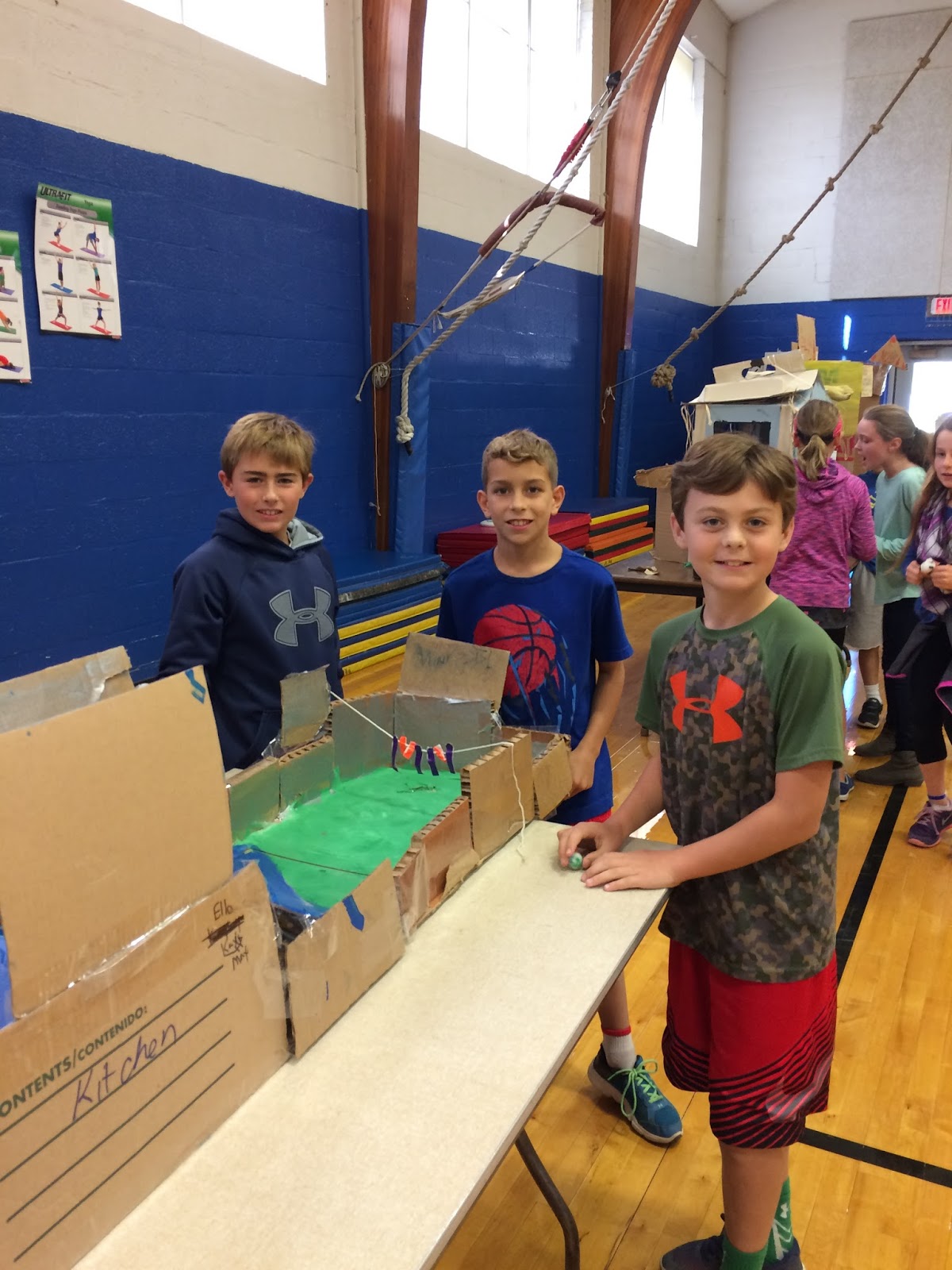
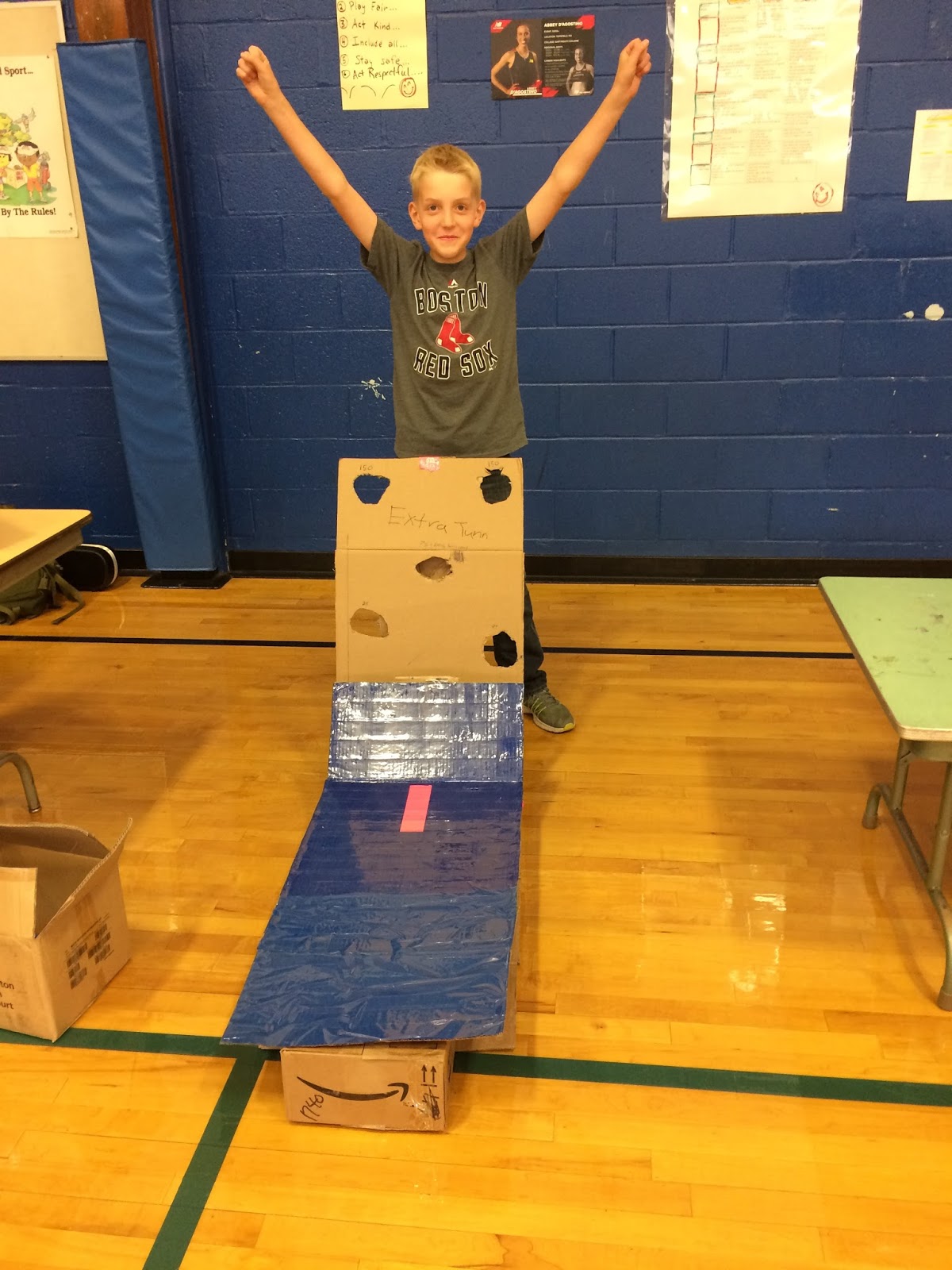
Inspired by the viral video "Caine's Arcade", the 5th grade class created an entire cardboard arcade! We learned about the engineering design process (constraints, the need to redesign, teamwork and consensus building, testing, etc.) while we constructed with cardboard.  The fun games and activities designed by the 5th graders were realized in the CLIC room with Mrs. Condon. Watching the imagination and creativity of 10 year olds take flight was truly inspirational. Take a look.

Trying out a game
Making an air hockey table


And trying out the air hockey table--it even has score cards!


Working in CLIC on a race course
             Mini golf anyone?                                                                                                       


 Skee Ball!


 And at the end of the day, everyone had a good time, learned the value of working together and making compromises, and understood that engineering is not a "once and you're done" proposition.


Wednesday, April 13, 2016

Erosion Models Are Awesome!

Now that spring is here, we can work on science labs outside!  Today was perfect for that.

If your student comes home with muddy knees, please forgive them.  We were working diligently on creating erosion models and had to get down on the ground in order to make them work.  Scientists use models to study processes that happen too slowly or on too large of a scale to observe directly.  And so, working in small trays with mud, water, rocks, toothpicks, and spray bottles works well for us to "see" erosion first hand.  We created deltas, carved caves, and smoothed out mountain tops all within a 30' by 15' space and in only 45 minutes!  Ask your student how they eroded today.


Thursday, March 17, 2016

Coordinate Grid Games

We've been studying coordinate grids and line plots in math.  While it's difficult to find games on the Internet involving line plots, there are many games to practice plotting points on a coordinate grid. Below are links to just a few.  Note that some games include working in all quadrants of a coordinate grid, positive and negative; we have only worked in the positive quadrant in class.  Have fun!


Tuesday, March 1, 2016

Boston Massacre Reenactment

We are fortunate to live in an area so rich with early American history.  We walk where colonists walked.  We see the actual houses in which they lived.  And this weekend, we can experience what it might have been like to be a colonist during the events which lead to the Revolution.

Our class has been reading a short book about the causes of the American Revolution.  In coming weeks, we will continue to learn more about the Revolution in Social Studies class as well.  But this weekend presents an opportunity which only occurs once a year--the reenactment of the Boston Massacre which Paul Revere used so effectively to stir Patriot sentiments.  The Bostonian Society will be presenting a reenactment of the massacre at 7pm this Saturday, March 5.  Please visit their website to learn more (http://www.bostonhistory.org/?s=osh&p=calendar#upcoming).  With Boston so close, I wanted to share this information with you and your family to take advantage of living history.

Saturday, February 13, 2016

Toilet Paper and Science??

First off, thanks to all you parents for supplying your child with a roll of toilet paper for school.  I'm sure you thought it was a curious request.  And then to be told by your student that it had to be at least 150 feet long. What could possibly be up with that?  We couldn't do science without it!  And thanks to the Exploratorium museum in San Francisco (http://www.exploratorium.edu/) for developing such a great tool to calculate planetary distances.

What is all of this about?  Toilet paper?  Distances?  Science?  How can all of this go together?

Over the past few days, we've been building toilet paper solar systems!  Yes, that's right.  Our entire solar system (including lowly dwarf planet Pluto) on a roll of toilet paper.  The Exploratorium started us off with a program to calculate the relative orbits of all of the planets if the sun was the size of a 1 cm cube (about the size of a pea).

We quickly realized that measuring each time from the sun out to each individual planet would take way too much work. (Would you want to measure out 43 meters all the way to Pluto?!)  There had to be an easier way.  Fortunately, there was.  Using the measurements that the Exploratorium program provided, we could calculate the distance between planets.  This fit readily with our study of decimals in math as we had to convert from hundredths of a meter into meters and centimeters.  Lots of decimal subtraction, understanding of place value, and rounding ensued!

Then came the measuring!  And teamwork.  And figuring out how you can measure out 11 meters in the classroom when eight other teams of students were trying to do the same thing without moving all the desks and chairs out of the way!  Could it be done?!  Of course!  Fifth grade inventiveness and teamwork really kicked in.

We will finally get to unroll our solar systems (and add asteroid belts) next week.  We will need a whole lot of space to do that.  There is only one place in the school where we can do this, and it's not the gym.  In the meantime, enjoy these photos of our solar system building in action.


Measuring with a partner--one person measures, the other holds the place.

Using teamwork in a confined space.
How far to Pluto??


Saturday, January 23, 2016

CLIC Light Lab

We recently wrapped up our unit on light energy with a visit to CLIC. Students had an opportunity to work with light in hands-on experiments using lasers to understand how light acts in fiber optic cables. Mrs. Larussa explained how these properties of light have implications in our everyday technology (cell phones, Internet, cable television just to name a few).  Pretty amazing to think that the seemingly simple stuff we study in 5th grade science has application to the real world.

         Light moving through a stream of water.  The light follows the path of the water.

Observing light reflecting through gelatin "fiber".

Tuesday, January 5, 2016

Change Is Simple

     Today we had educators from Change Is Simple visit our classroom to teach us about energy--where it comes from, how much different appliances in our households use, and what we can do to not waste it.  They brought hands-on activities to really help the students understand the value of energy.  Did you know that a hairdryer uses almost 1300 watts??!  That's about 100 times as much energy as an LED bulb.  And a small, handheld vacuum cleaner uses over 200 watts.  It makes you rethink using a simple broom or dust mop to clean your floors.  And cranking up enough energy to light a standard incandescent bulb takes a lot of hard work!

     Change Is Simple will be visiting our school periodically until the end of the school year, bringing more hands-on opportunities to learn about energy and what simple changes we can make to impact our world.  Check them out at their website http://www.changeissimple.org/


Cranking away to light a 60 watt incandescent light bulb!


Patrick showing us a "model home" and where we can save energy.


Gillian using a wattage meter to show how much energy is used by different common appliances in our homes.

Wednesday, November 11, 2015

Our Final Days of DASH

Trying to cut and write with our non-dominant hands
With fifth grade comes the last unit of DASH presented to Topsfield students.  This year, students worked through physical disabilities.  The first week was centered around fine motor disabilities, with various simulations in the classroom.  It may look like all fun (and there is some fun involved), but students take away a greater understanding and appreciation of how people can be different yet capable of the same things. Isn't it a great and wonderful thing that we are all different?


Learning about various tools that someone with a disability might use and how they work.

Using a communication board requires a lot of concentration.


Trying to get dressed without the use of our hands.


Students also tried out various equipment for gross motor disabilities during their gym class. While it looked like fun, most students quickly realized how difficult it was to carry their book bag or their lunch while using the crutches or wheel chairs.

Looks easy, but trying carrying a backpack too.


Getting dressed and up and about when you can't move your leg.

Trying out the crutches.


Thank you to all the volunteers that helped with DASH this year.  It couldn't happen without you!
Four square with just one hand.

Saturday, October 31, 2015

Strawbery Banke Visit

The weather was perfect for our field trip last week to Strawbery Banke in Portsmouth, New Hampshire.  Thank you to TESPTO for underwriting the trip.  We spent the day at this living history museum just a few blocks from downtown Portsmouth.  Traveling back and forth in time, we explored the houses, hobbies, and lives of the immigrants that moved to this neighborhood.  The students particularly enjoyed trying on the clothes of colonial children, commenting that there were so many layers to put on.  They also considered what it would be like to come to Strawbery Banke when they assumed the roles of various immigrants to the area, from Irish servant to colonial slave.  I encourage you and your families to take another visit to Strawbery Banke to find out even more about this little local gem.  Check out the website at www.strawberybanke.org

Watching the meals being cooked.  That's a tray of dried pumpkin
which can be reconstituted with water.


The baseball hat is a bit out of time.
Dashing!

This was a favorite coat for the young men.

Smiles!

There was still another layer to put on.


Ahoy, mates.  Outside the woodworking shop.